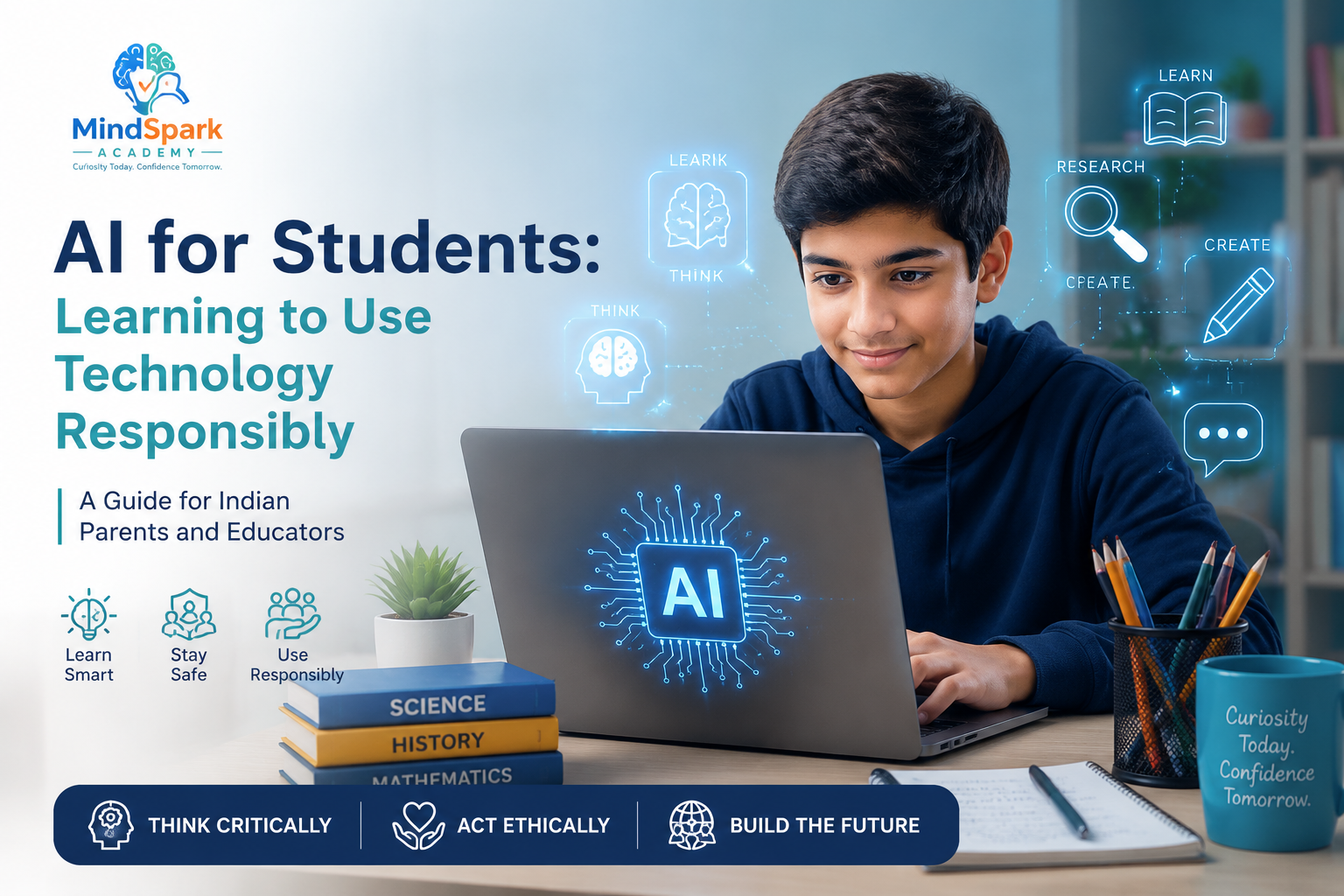
AI for Students: Learning to Use Technology Responsibly
A Guide for Indian Parents and Educators
Quick Summary
- How students are using AI today.
- Benefits and risks of AI in education.
- Guidance for teachers and parents.
- Building responsible AI habits.
How Students Are Already Using AI Every Day
Artificial Intelligence is already becoming part of everyday learning. Whether students realise it or not, AI is helping them search, understand, create and practise new concepts every single day.
Understand Difficult Concepts
Ask AI to explain algebra, grammar, history or science using simple language, examples and step-by-step explanations.
Improve Writing Skills
Refine grammar, vocabulary and sentence structure while keeping your own ideas and writing style.
Prepare for Exams
Generate revision notes, flashcards, summaries and practice questions before examinations.
Learn Coding
Understand programming concepts, debug simple errors and explore new coding languages with confidence.
Benefits of Artificial Intelligence in Education
When used responsibly, Artificial Intelligence can make learning more engaging, personalised and accessible.
✅ AI Can Help Students
- Explain difficult concepts in simple language.
- Create personalised revision notes.
- Generate practice quizzes and flashcards.
- Improve grammar and writing skills.
- Support coding and problem-solving.
- Translate languages and improve communication.
🚫 AI Cannot Replace
- Teachers and classroom discussions.
- Critical thinking and curiosity.
- Creativity and original ideas.
- Ethical decision-making.
- Human relationships and empathy.
- Real-world experiences.
Artificial Intelligence is a Powerful Learning Tool…
…but only when students learn to use it responsibly, think critically and continue developing their own ideas.
Risks Every Student Should Know
⚠ AI is a Learning Assistant, Not an Answer Machine
Students should avoid copying AI-generated homework without understanding the concepts. Real learning happens when students think, question and solve problems themselves.
Copying Without Learning
Using AI to complete homework without understanding the concepts can weaken critical thinking and long-term learning.
Incorrect Information
AI can sometimes generate inaccurate or outdated information. Students should always verify important facts using reliable sources.
Privacy Risks
Never share personal details, passwords, school records or private photographs with AI tools.
Overdependence
AI should support independent thinking, not replace problem-solving, creativity and original ideas.
Five Principles of Responsible AI Use
Artificial Intelligence is most effective when it supports learning rather than replacing it. Every student should develop these five habits while using AI.
Think First
Try solving the problem yourself before asking AI for help.
Verify Information
Always cross-check important facts with textbooks or trusted sources.
Protect Your Privacy
Never share personal information, passwords or private documents.
Use Your Own Ideas
Use AI to improve your work—not to replace your creativity.
Keep Learning
AI is a learning partner. Your curiosity and thinking remain your greatest strengths.
A Blueprint for Teachers
Teacher Tip
Instead of asking students, "Did you use AI?" ask "Show me how AI helped you learn." This encourages honesty and makes AI part of the learning process rather than something students try to hide.
Teachers can encourage responsible AI use by focusing on understanding rather than memorisation, encouraging discussion, oral presentations, classroom activities and project-based learning.
A Blueprint for Parents
Parent Tip
Instead of asking "Did you finish your homework?" try asking "What did AI help you understand today?" This encourages curiosity and conversation instead of dependency.
Parents should guide children in using AI responsibly by encouraging independent thinking first, discussing AI-generated answers together and maintaining a healthy balance between technology, books, outdoor activities and family conversations.
Future-Ready Skills That AI Cannot Replace
Critical Thinking
Communication
Emotional Intelligence
Ethical Decision Making
Artificial Intelligence can generate information, but only people can apply wisdom, empathy, creativity and ethical judgement. These human skills will remain essential in the future.
Responsible AI Checklist for Students
- ✅ I use AI to learn, not to copy.
- ✅ I verify AI answers using trusted sources.
- ✅ I protect my personal information.
- ✅ I think before I believe.
- ✅ I ask better questions to get better answers.
- ✅ I continue reading books and solving problems on my own.
- ✅ I respect my teachers' instructions regarding AI use.
- ✅ I use AI responsibly and ethically.
Frequently Asked Questions
Prepare Students for an AI-Driven Future
MindSpark Academy's Artificial Intelligence for Students workshop helps learners understand AI, use it responsibly, think critically, identify misinformation and build future-ready skills aligned with the National Education Policy (NEP 2020).
Continue Reading